

Digital products are a constant part of our daily lives: Whether we’re planning our route on public transportation and buying a ticket, comparing different products before making a new purchase, or reserving a conference room at work—all of these activities, and many more, are made easier today by countless digital products.
Every successful product starts with a problem
Developing a successful digital product that makes everyday life easier—and perhaps even delights users—starts with a clear problem statement. Too often, companies invest in features and technologies before they have truly understood user needs. Often, it isn’t even clear for which users a product is being developed.
At its core, there must be one question right from the start: What problem do we want to solve—and for whom?
A structured process for digital product design ensures that a problem statement and a solution idea are transformed into a successful, user-centered product.
The digital agency dmcgroup helps companies develop successful digital products. In this article, we’ll provide an overview of the typical phases of digital product development.
Discovery Phase: What problem are we solving—and for whom?
The overarching goal of this phase: To identify the problems faced by potential customers and users and to assess the market for them.
The most important question in digital product development must be asked at the outset: What problem do we want to solve—and for whom?
Avoid “getting attached” to solutions too early, before the underlying problem has been thoroughly examined. All too often, this leads to products that do not address valid problems or solve them only inadequately.
That’s why we typically begin the discovery phase of digital product development by examining potential target audiences and user profiles. In empathy and ideation workshops with our clients, we develop a shared understanding of customers, their pain points, goals, and everyday challenges (e.g., in their professional lives or in relation to a very specific task).
Ideally, this analysis is already based on existing data, such as interviews, surveys, or observations of users.
Subsequently, the identified problems can be described in specific problem statements, and any existing potential solutions can be examined as part of a market and competitive analysis.
Methods Used in the Discovery Phase
- Interviews & Surveys
- Customer Profile Analysis: Customer Pain Points, Goals, Challenges, Tasks
- Creating Personas
- Formulating Problem Statements
- Market/Competitive Analysis
Tip: It’s essential to involve internal stakeholders from different departments—they’re familiar with processes and pain points, since they’re often in direct contact with customers or have insights into the company that are invaluable for ideation.
Impact: Digital products based on real user needs are significantly more successful and reduce the costs of future adjustments. It is therefore worth setting aside sufficient time for the discovery phase.
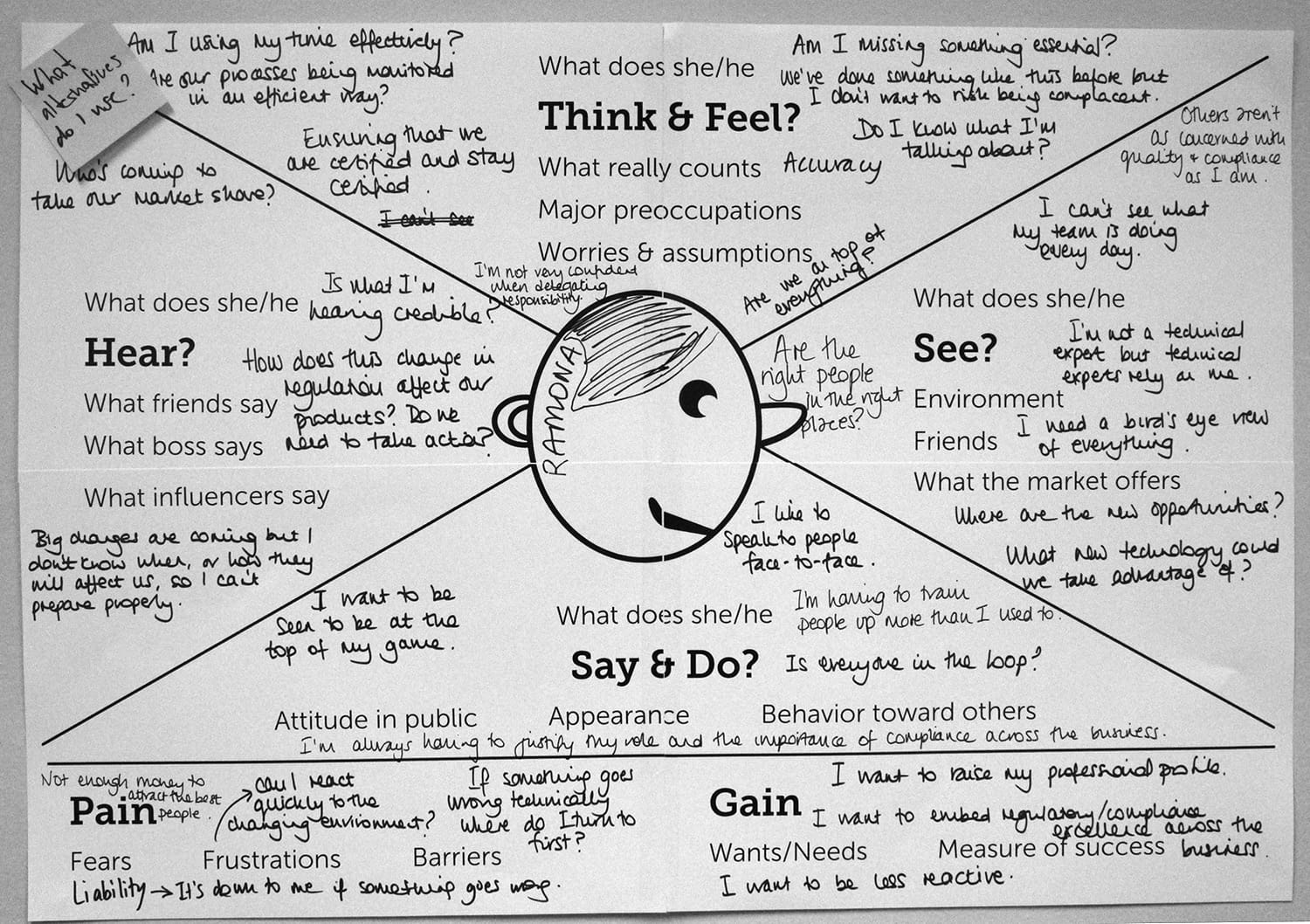
A persona poster from one of our Inception workshops. We use these workshops to define the project together with our client and develop empathy for potential target audiences and users.
Definition Phase: Formulating Hypotheses and Requirements
The overarching goal of this phase is to derive solution hypotheses from problem statements and align requirements with business objectives.
Based on the insights gained during the discovery phase, initial sketches of potential solutions can be developed in design thinking workshop formats, and corresponding hypotheses can be formulated.
Hypotheses formulate testable assumptions about the relationship between a proposed solution and an expected effect. These hypotheses help in developing clearly defined solutions to identified customer problems; at the same time, they enable the early validation or falsification of ideas. This can be done through small experiments during the definition or prototyping phase.
For example, to gauge demand for a new feature that would complement an existing product, a so-called “fake door” (a simple information page or sign-up option) can be used, which allows you to quickly determine, with minimal effort, whether there is interest in the market.
Formulating potential solutions as hypotheses also makes it possible to prioritize different features even before prototyping and implementation begin. This allows for the prioritization of those features that best contribute to business and user goals.
As potential solutions and features become more concrete, we recommend creating a comprehensive overview of the product scope using a storymap. This serves as the foundation for the subsequent implementation phases and allows the team to adjust the project’s priorities and scope at any time.
Methods in the Definition Phase
- Select and sketch ideas
- Formulating Hypotheses
- SWOT Analysis
- Validate Market Demand
- Business Model Canvas
- Story Mapping
- Feature Prioritization
Tip: Focus on core features that deliver the greatest value to both customers and the business.
Impact: Hypotheses and a story map are a milestone on the path to a digital product. This lays the foundation for efficient and structured implementation and minimizes feature overload.
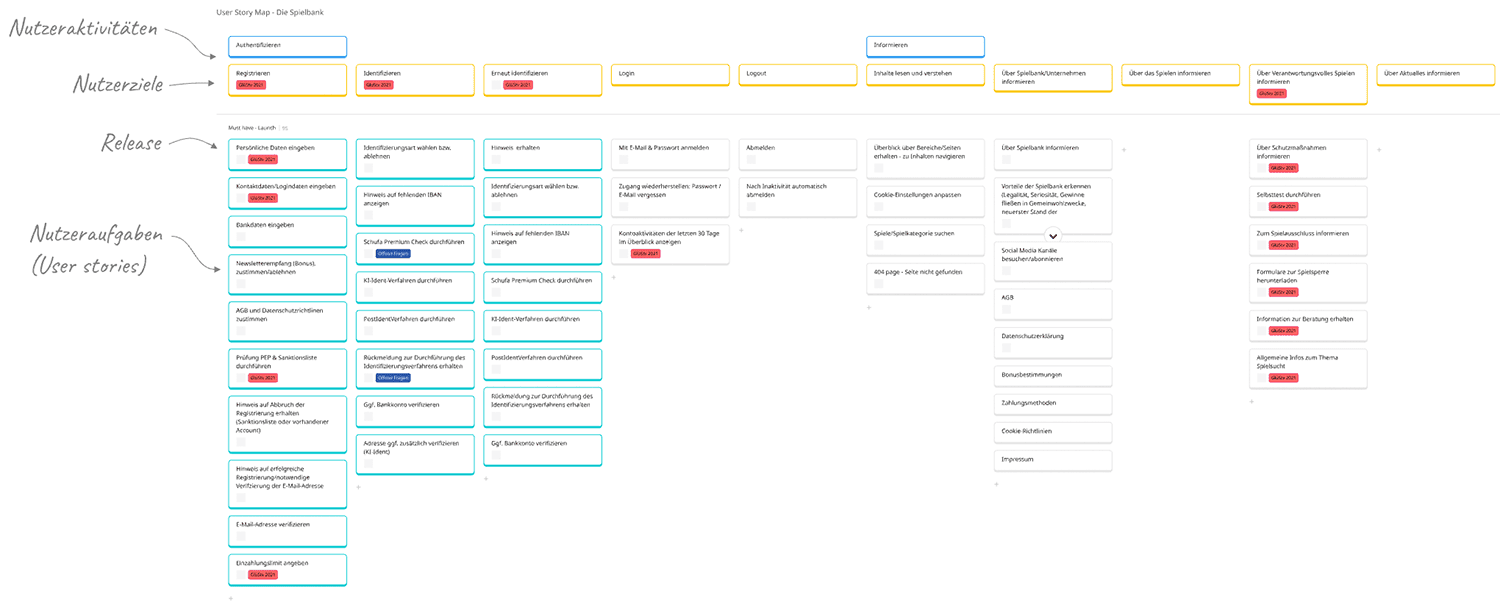
During the definition phase for the casino, we created a comprehensive story map that served as the basis for our estimation and implementation work.
Learn
more
Prototyping Phase: Visualizing and Testing Ideas
The overarching goal of this phase: to bring ideas to life and validate them.
The next step is to test the ideas and theoretical hypotheses. To do this, prototypes should be used—that is, more or less simulated visualizations of the product idea that do not yet require an actual technical implementation.
Depending on the time and resources available, there are various methods for creating prototypes. These differ in terms of “fidelity”—that is, how realistic the simulation “feels.”
Often, however, “less” is “more” in this context—or to put it another way: it’s better to arrive at test results quickly than to spend a lot of time creating elaborate prototypes. After all, this phase is primarily about gaining insights and testing our assumptions. Often, even simple paper prototypes or clickable “low-fidelity” prototypes are sufficient for this purpose.
At the end of this phase, we have design hypotheses that have been either verified or falsified. This allows us to formulate new hypotheses and test them again—until we have sufficient verification to begin the actual implementation.
Methods Used in the Prototyping Phase
- Paper prototypes
- Wireframes & Clickable Mockups
- Usability Testing & Participant Observation
- Validation/Falsification of Hypotheses
Tip: Prototypes should be tested with real users whenever possible. This is especially true when the product is intended for very specific target audiences. If the target audiences are very broad, the careful selection of test users during the prototyping stage is not as important.
Impact: Design assumptions are tested and thus either verified or falsified. Early error detection prevents costly missteps and allows for cost-effective course corrections before a product is actually implemented.
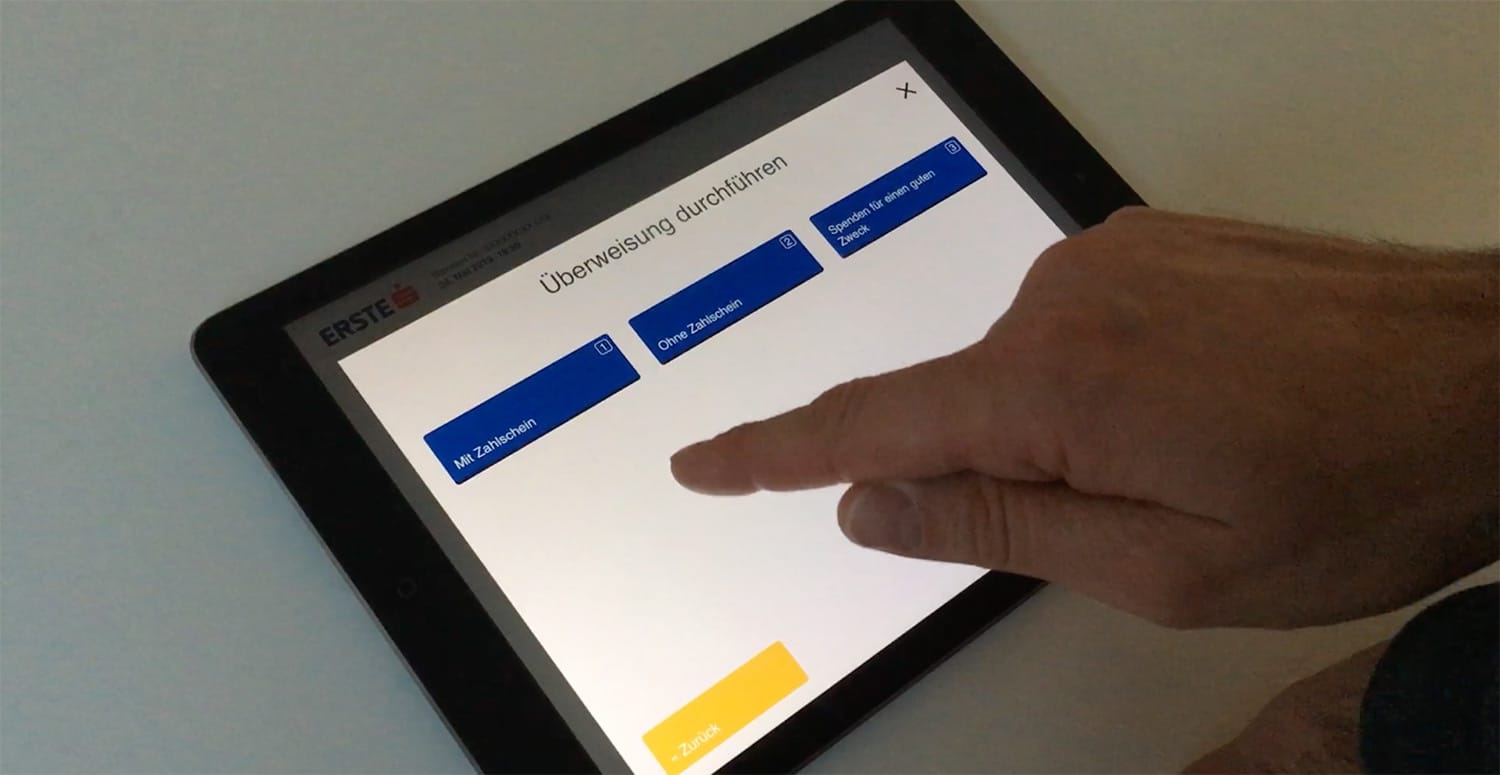
A simple low-fidelity click dummy was used in the early conceptual phases of the redesign of ATM user interfaces.
Build Phase: Agile Development and Implementation
The overarching goal of this phase: A digital product team uses a sprint-based process to turn a prototype into a working product that is ready for market launch.
The build phase is about turning a validated product idea into an actual, functioning digital product.
We recommend that this be implemented by a cross-functional team using an agile workflow, as this approach offers the necessary flexibility and efficiency. Based on the story map developed earlier—which is continuously updated and expanded within the agile workflow—the digital product becomes more complete with each sprint.
Continuous deployment allows for testing throughout the development process and prevents the product from not being ready until after a long development period. On the contrary: The team’s prioritization follows the initial feature prioritization. This ensures that the product’s essential core functions are implemented first so they can be tested more thoroughly and modified if necessary.
This approach also significantly reduces “time to market”—initial versions of the product with a greatly reduced feature set can be used long before a comprehensive version is completed.
Methods in the Build Phase
- Implementation in an Agile Workflow
- Cross-Functional Teams for Efficient Implementation
- Continuous Integration/Deployment
Tip: Regular reviews ensure that the product meets requirements and user needs. An acceptance procedure agreed upon with the customer ensures organizational clarity throughout the process.
Impact: Fast, flexible, and high-quality—delivering a fully functional digital product—the core promise of agile product development.
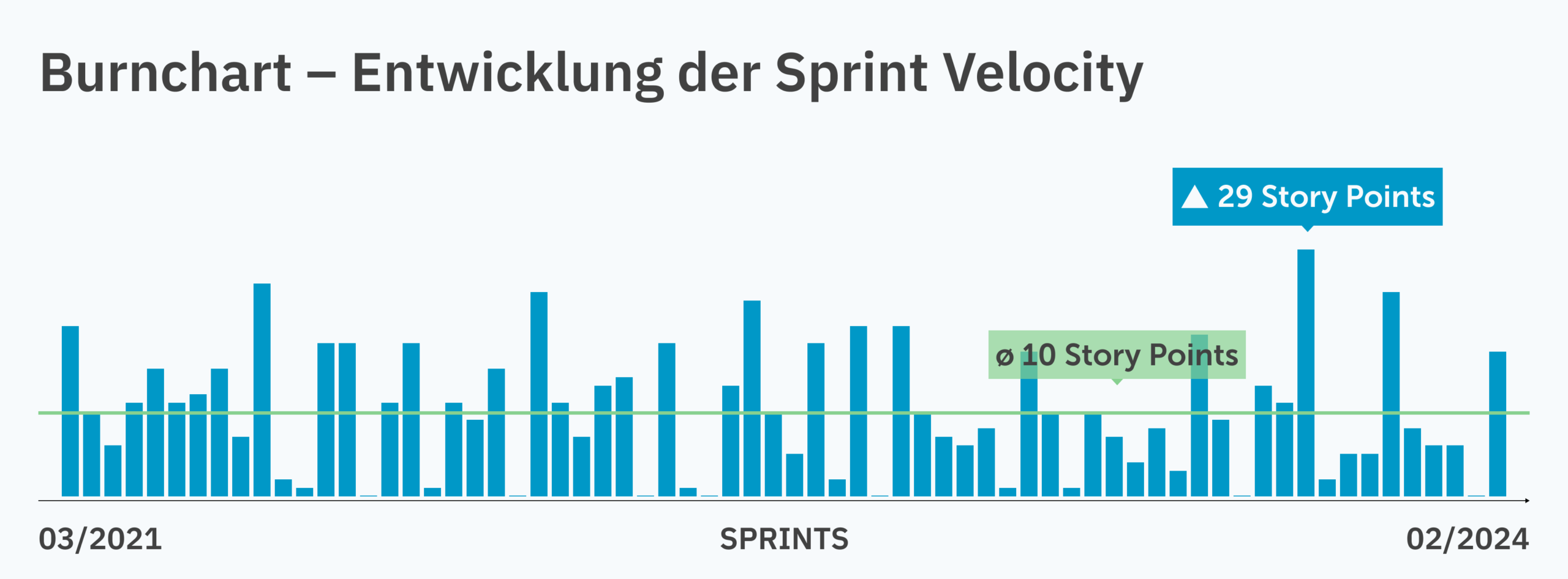
In digital product development for Situation R, we rely on an agile workflow for design and software development. The burn chart shows the continuous output over many sprints.
Launch Phase: Continuous Optimization Right from the Start
The overarching goal of this phase: Launch the product, gather user feedback, and continuously improve it.
A common mistake in digital product development is to view the launch as the final step in the product development process. In reality, that’s when things really get started.
Despite early market analysis, testing of design hypotheses, and user testing with prototypes, it is only the actual market launch that provides a reality check on the product’s acceptance.
Using user research methods to monitor the product launch and the period that follows—in order to gather feedback from users—can provide valuable insights for continuous optimization. This way, even good products keep getting better over time.
Methods for the Launch and Post-Launch Phases
- Analytics & KPI Monitoring
- Usability Testing & Participant Observation
- Iterative Improvement & Updates
Tip: Think of the launch of your digital product as a starting point, not an endpoint.
Impact: Continuous product improvement leads to sustainable success, high user satisfaction, and long-term product acceptance.
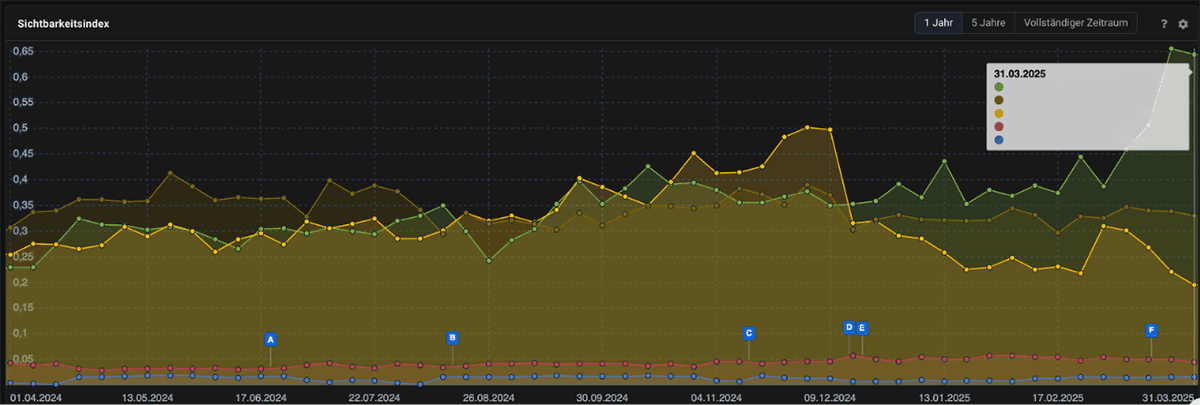
Once the product is launched, the digital product design process really gets underway. We rely on continuous monitoring, analytics, and reporting—for example, using ahrefs or Google Data Studio.
Digital product design is not a self-contained, linear process
The path from problem to digital solution is not a linear process, but rather an iterative cycle. Nor is there a single “roadmap” that works for all projects, clients, and starting points. We’d be happy to develop a customized plan for you to get your digital product off the ground.
Using structured methods and a focused approach, risks can be significantly minimized throughout the process, enabling the development of products that meet user and business goals and have the potential to generate genuine enthusiasm.
Go digital!
Digital product design with dmcgroup —from analysis through prototyping and development to a successful launch and ongoing refinement. Schedule a personalized consultation to turn your idea into a lasting success.
Digital Product Design: Questions & Answers
Here you’ll find answers to the most important questions on this topic. If you have any specific questions, we’re of course happy to assist you directly!
What is digital product design?
Digital product design refers to the structured process by which a user-centered digital product is created from a problem statement and a solution idea. The goal is to develop digital solutions that meet real user needs and are both functionally and economically successful.
How does the digital product design process work?
The process is divided into several phases: Discovery (understanding problems and target audiences), Definition (formulating hypotheses and requirements), Prototyping (testing ideas), Build (agile development), and Launch (market launch and optimization). This process is iterative, meaning that phases can be repeated to incorporate feedback and new insights.
Why is it important to analyze users and their needs from the start?
A thorough analysis of users ensures that digital products solve real problems and do not miss the mark when it comes to user needs. Understanding user needs, goals, and pain points early on leads to the development of solutions with higher acceptance, avoids wasted investments, and saves costs associated with later adjustments.
What Are the Benefits of Prototyping in Product Development?
Prototyping brings ideas to life before they are technically implemented. Clickable mockups or simple paper prototypes allow assumptions to be quickly tested and validated. This helps prevent misguided developments early on.
What happens after a digital product is launched?
The work isn’t over after the launch—quite the opposite: it’s only through market feedback that we can determine how well the product is being received. Using methods such as analytics, usability testing, and iterative updates, the product is continuously improved and set up for long-term success.
Is digital product design a linear process?
No, digital product design is an iterative cycle. Depending on the project, the steps—discovery, definition, prototyping, build, and launch—may be repeated multiple times to incorporate user feedback and continuously optimize the product.
Is the digital product design process always the same?
No, the process isn’t always the same. While there are established phases such as Discovery, Definition, Prototyping, Build, and Launch, every project has its own requirements, goals, and constraints. Therefore, the process is customized to develop the best solution for each specific situation. Contact dmcgroup to receive your customized implementation plan.
Von den aktuellsten Branchen-Trends, über neueste Insights zu KI und UX/UI-Design, bis hin zu spannenden Use Cases.
Melden Sie sich für unseren monatlichen Newsletter an und bleiben Sie immer up to date!
Stay
tuned
More articles
Find out more about our working methods and helpful tips and tricks on the subject of online marketing.
Generative Engine Optimization—GEO Is Not the Answer
Mut zur Klarheit: Mit Mini-Budget zu maximaler Sichtbarkeit für Tabuthemen

Niche Visibility Through AI